Inside LB3 Public Letter: 1st Spiritual HealthTech · Edition #01
Authors: Leonardo Bonagura & LB3 Second Brain Guild
1. The illusion of conversational productivity
Most organizations that declare themselves AI-driven today have merely distributed chat assistant licenses to their teams or attached text interfaces on top of legacy workflows. In the short term, generation speed is impressive: screens, code routes, and documents appear in minutes. Soon after, however, the hidden liability emerges: syntactically plausible code that silently violates business rules, inconsistent data contracts, and automated tests designed only to confirm behavior the machine itself just invented.
This superficial adoption produces three structural weaknesses in technology enterprises:
1. Institutional Amnesia: Language models have no continuous memory across sessions. When a dialog window closes, architectural context vanishes and the organization re-litigates premises that were already decided.
2. Accelerated Technical Debt: Without formal specifications and verification gates, generation speed turns into rework volume. The central engineering question shifts from "can AI write this code?" to "how do we mathematically guarantee that delivered code respects the business contract?".
3. Unchallenged Statistical Conviction: A model operating in isolation does not doubt its own premises. Faced with a documentation gap, it fills the void with plausible inferences and approves its own logic without resistance.
For teams building mission-critical infrastructure in healthcare and human care, as we do at LB3.Digital, pioneer in Spiritual HealthTech, operating on statistical improvisation is unacceptable. Our architecture simultaneously powers three integrated ecosystems:
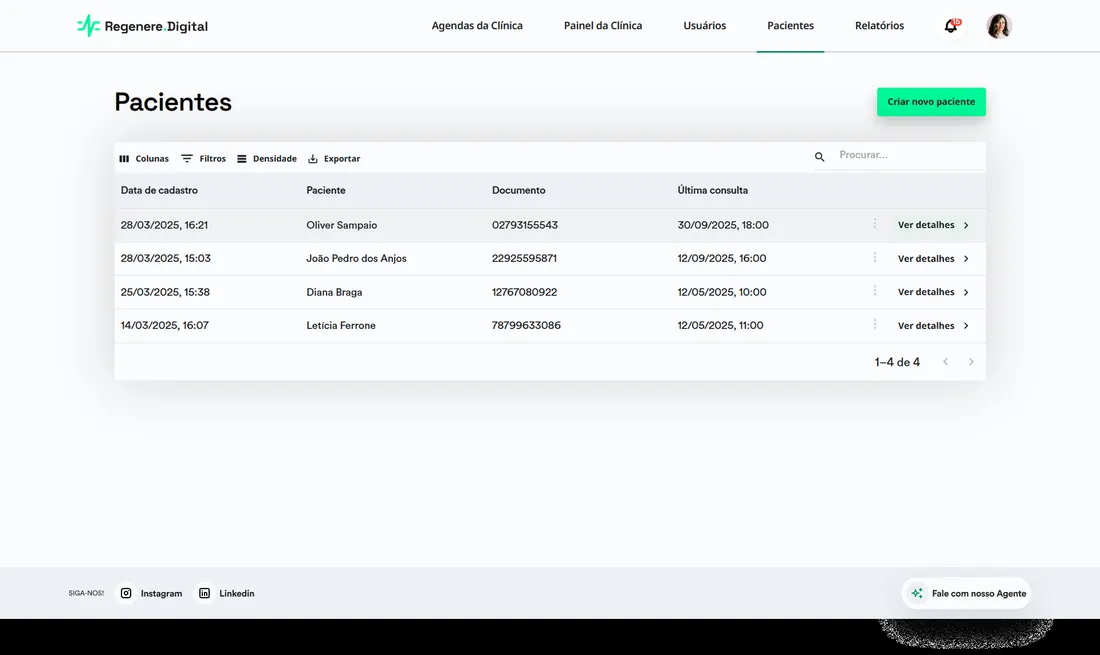
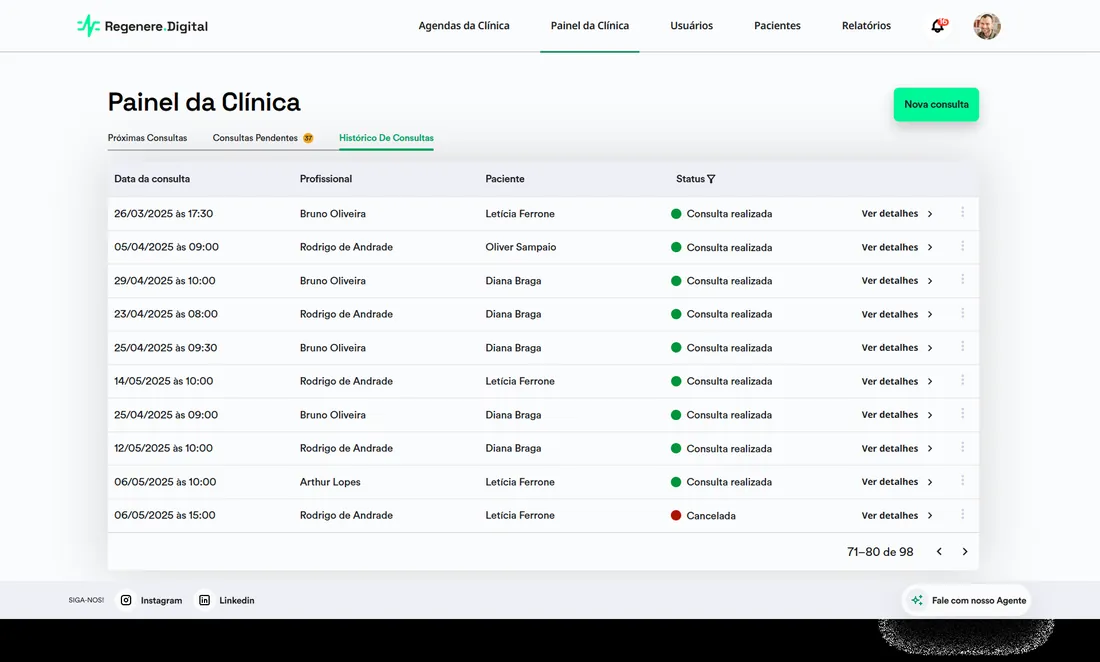
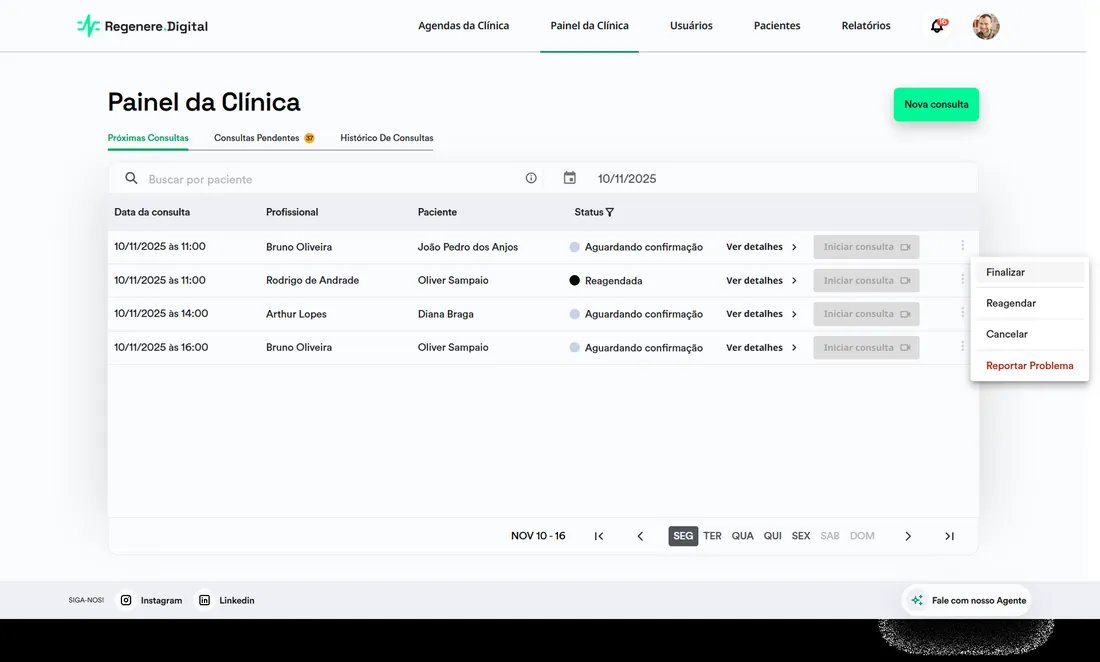
•Regenere.Digital: Integrative medicine and Electronic Health Record (EHR/PEP) clinical platform, handling sensitive clinical data, regulatory compliance, and patient safety.
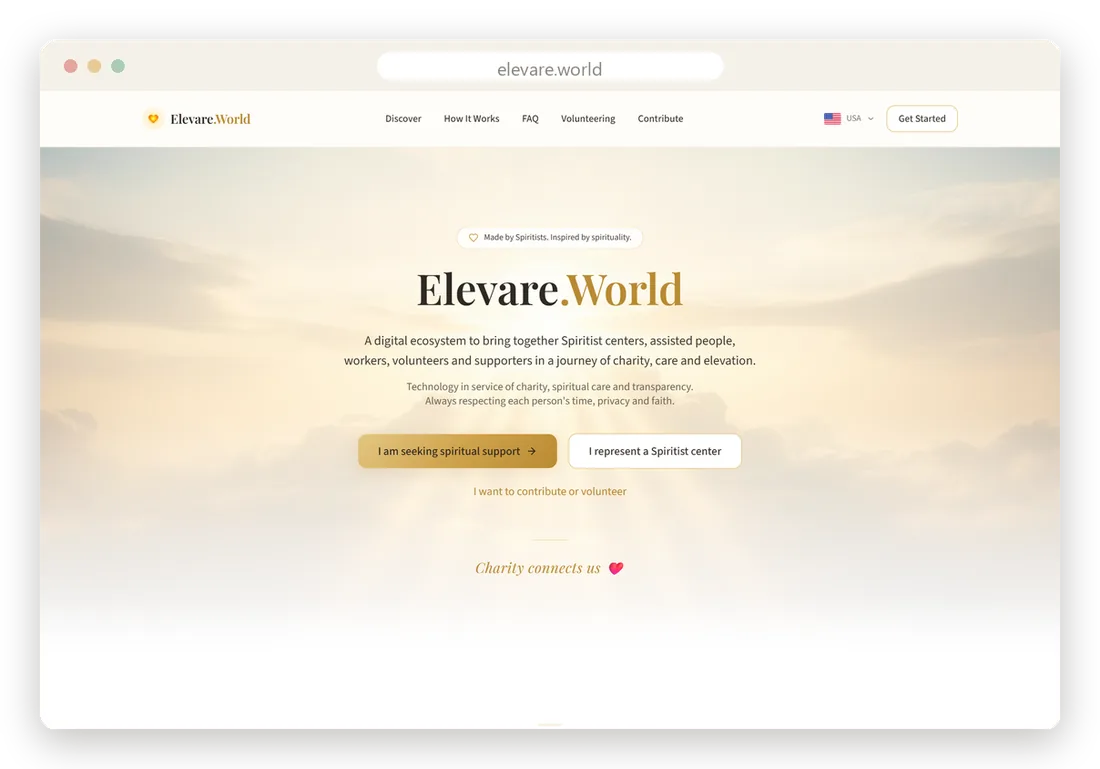
•Elevare.World: Platform for spiritual care centers and community well-being, protecting religious conviction data, fraternal care, and scale operations.
•lb3.gov: Constitutional layer of multi-agent governance and continuous oversight, ensuring systemic integrity, contract traceability, and drift containment.
The clinical and spiritual platforms communicate through standardized HL7 FHIR buses while maintaining strict domain isolation. To meet this challenge, we engineered LB3.Digital on top of a dedicated cognitive nervous system: the LB3 Second Brain.
2. From personal note-taking to AI-Native corporate infrastructure
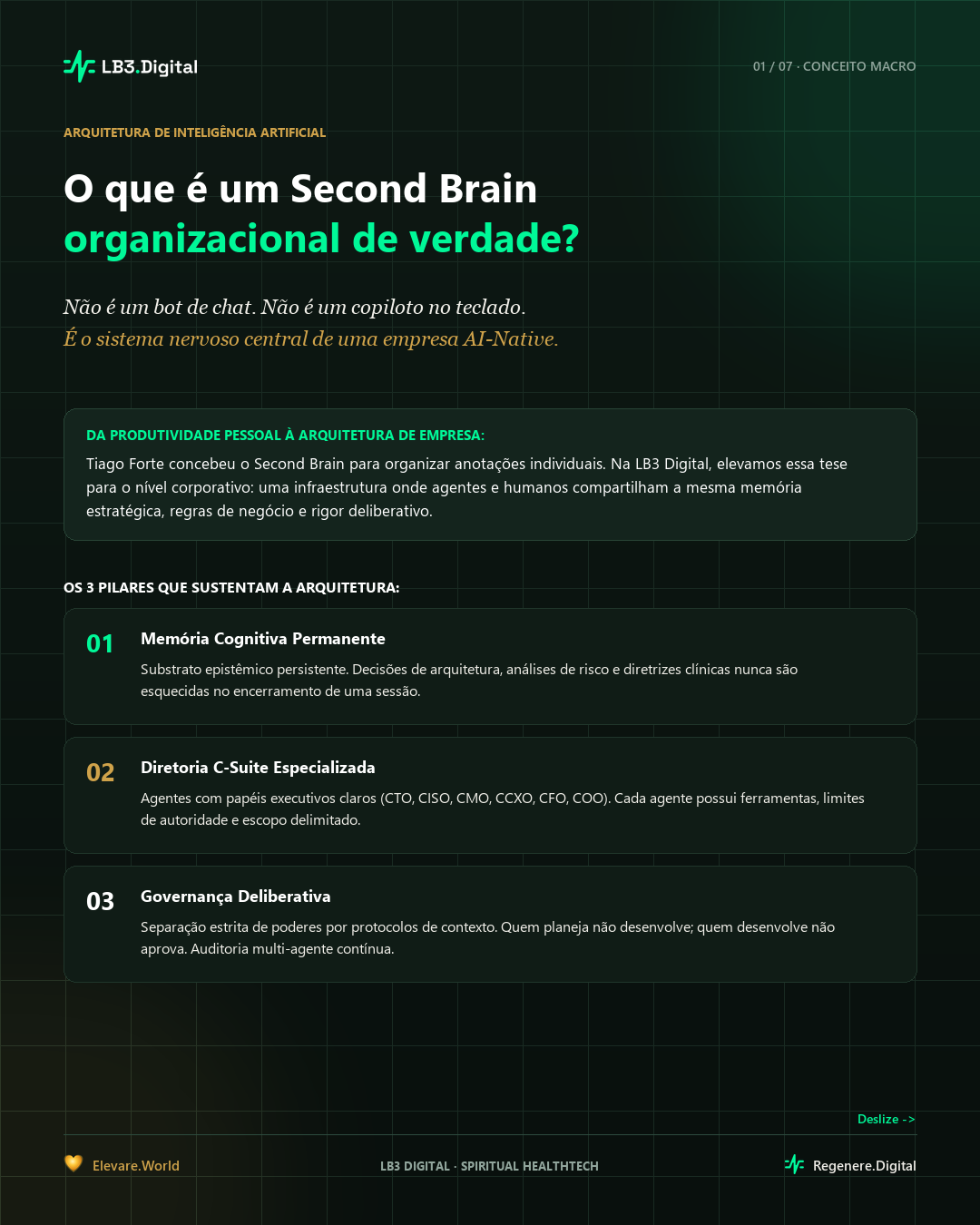
The term Second Brain became popular in personal productivity literature (notably with Tiago Forte) as a method for organizing personal notes. In LB3.Digital architecture, the concept was redesigned from the ground up to solve an entirely different problem: coordinating multiple artificial intelligences at enterprise scale.
Four properties define the Second Brain as native infrastructure for the multi-agent era:
1. Cognitive permanence beyond the session window: Language models reset state on every API call. The Second Brain acts as the permanent cortex of the company: every architectural decision, domain rule, cataloged failure mode, and technical verdict becomes persistent heritage, retrievable in milliseconds by any authorized agent.
2. Native machine-to-machine production and reading under human direction: Of the 1,606 structured documents in our production repository, nearly all were generated by specialized agents to be consumed by other agents across the engineering pipeline. Human executives and engineers retain strategic command and sovereign approval.
3. Active memory with constitutional veto power: Memory operates as an active governance gate: it scores specification readiness, blocks immature coding, and requires physical proof of tests and database persistence for every critical risk identified.
4. Interoperability under checks and balances across five families: No single AI provider holds hegemony across all cognitive skills. Our infrastructure connects models from Anthropic, OpenAI, DeepSeek, xAI, and Google on a unified PostgreSQL and pgvector substrate.
3. The Multi-Agent Executive Board and Specialist Matrix
We structured the Second Brain into two complementary governance layers: a Multi-Agent Executive Board (C-Suite) and a Cognitive Family Engineering Matrix.
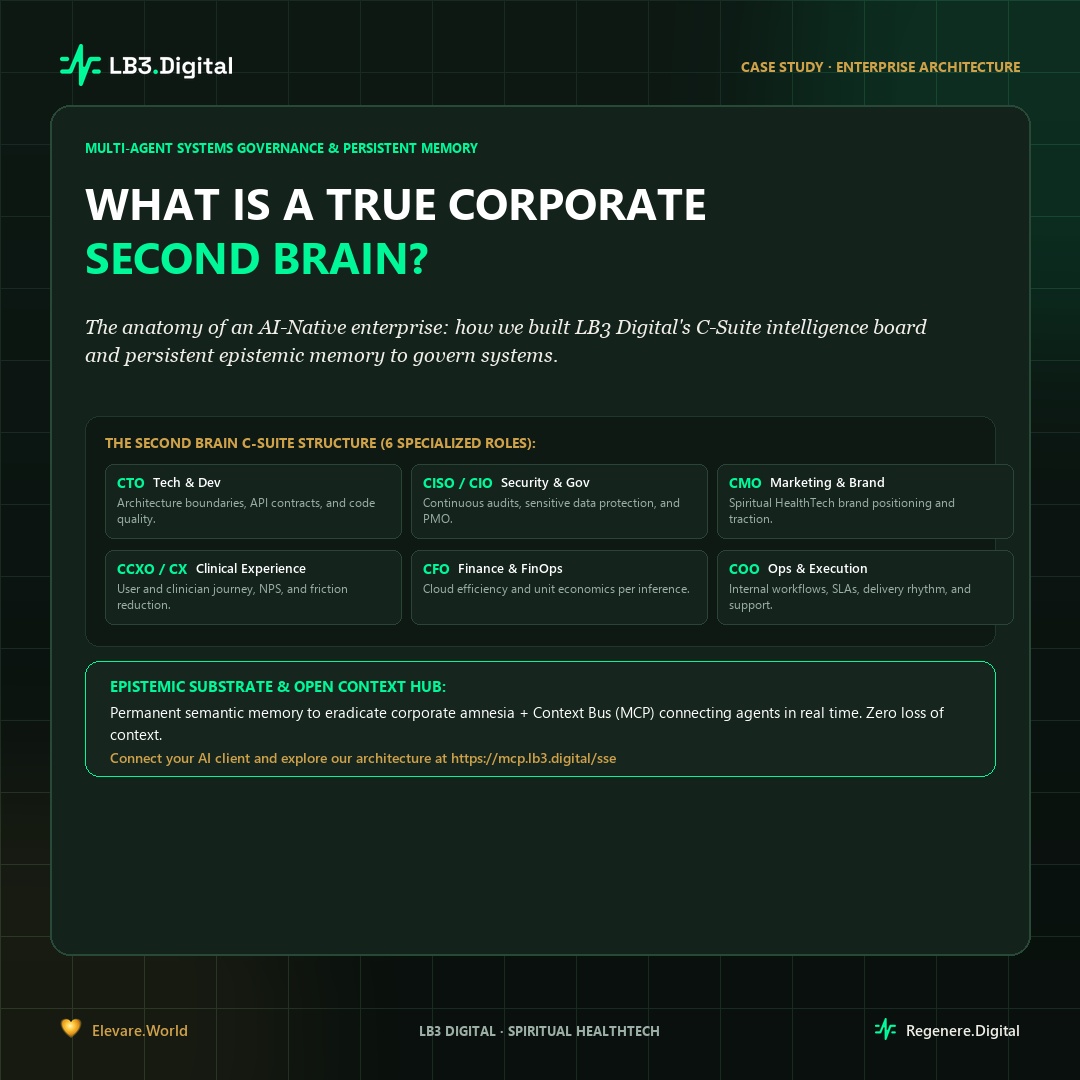
At the strategic level, six executive agents safeguard operational balance:
•CTO (Technology & Architecture): Governs architectural standards, repository boundaries, API contracts, and technical hallucination containment.
•CISO (Information Security & Compliance): Conducts continuous vulnerability scans, sensitive health data protection, and regulatory compliance.
•CMO (Positioning & AI-to-AI Channels): Ensures institutional brand authority, scientific distribution across human and machine channels (llms.txt and public MCP), and factual precision.
•CCXO (Clinical Experience & Care Journey): Monitors operational fluency for physicians, therapists, patients, and care recipients.
•CFO (Finance & Inference FinOps): Evaluates compute efficiency, economic routing across models, and return on token spend.
•COO (Operations & PMO): Coordinates the cross-repository master plan, delivery SLAs, and execution cadence.
At the technical execution level, we replaced reliance on a single generalist model with a strict separation of powers across five AI families:
•Planning & Architecture (OpenAI GPT-6 Astra with cross-review by Anthropic Claude Opus 5.5): Decomposes business demands into executable plans and specifications (.mdoc).
•2-Round Quality Assurance (OpenAI GPT-6 Astra in R1 and Anthropic Claude Opus 5.5 in R2 under Anti-Goalpost lock): Verifies strict compliance of specifications and code.
•Backend BFF Development (OpenAI GPT-5.3 Codex with peer review by GPT-6.1 Sol): Implements services, transactional migrations, and API contracts.
•Frontend Development (Anthropic Claude Sonnet 5.5 with peer review by GPT-6.1 Sol): Builds interfaces, visual states, and accessibility.
•Reliability Engineering FMEA (DeepSeek V4 Pro with adversarial challenge by xAI Grok 4.7): Maps failure modes and challenges mitigation optimism.
•Multimodal Orchestration & Execution (Google Gemini 4 Argon High under Human STOP Gate): Coordinates the local pipeline, physical tests, and database verification.
4. The constitutional rite: specify and measure before building
In LB3.Digital AI-Native engineering, no agent is authorized to write code autonomously from an informal request. The gravitational center of this architecture is the STOP gate. No code is born without a formal specification approved by the SD-FTR readiness scale and explicitly authorized by a human decision-maker. Today, our repositories track 1,368 .mdoc specifications in Git, maintaining a ratio above 1.27 formal specifications per code commit.
5. What production numbers reveal: 1,606 documents and 25,000 vectors
Every evaluated specification, risk opinion, peer review, and executive deliberation is stored in PostgreSQL, chunked, and converted into 1536-dimensional vectors (pgvector) for continuous semantic search:
•Structured documents persisted: 1,606 (410 SD-FTR scorecards, 396 specification reviews, 260 implementation reviews, 206 peer reviews, 128 architectural plans, 83 executive deliberations, 35 FMEA reports, 31 PMO digests, 30 frontend architectures, 11 backend architectures, 8 CISO security scans, 6 preventive decompositions, and 2 test reports).
•Vectorized chunks (1536d, pgvector): 24,991 semantic retrieval units (average of 15.6 chunks per document).
•Cumulative text volume: ~23.0 million characters.
•Versioned .mdoc specifications in Git: 1,368.
•Judgment and containment effort: 79.2% to 81.9% of the entire Second Brain corpus consists of critical evaluation, contract verification, and risk containment.
•Ecosystem distribution: Regenere.Digital with 766 documents (47.7%), Elevare.World with 575 documents (35.8%), and lb3.gov with 265 documents (16.5%).
6. Executive Synthesis: AI-Native Engineering Principles
•Memory precedes intelligence: No architectural decision resides in ephemeral chat history; everything is persisted and vectorized in a relational database.
•Constitutional separation of powers: The AI family that plans or writes code never holds authority to approve its own delivery.
•The bottleneck is verification, not generation: Design architecture to dedicate roughly 80% of cognitive effort to verification, peer review, and risk containment.
•Closed contracts before code: Measure readiness and ambiguity (drift) on every specification before releasing a single implementation token.
•Machine-verifiable transparency: Connect your AI client (ChatGPT, Claude, Cursor, VS Code) directly to our open connector at https://lb3.ia.br/mcp.